
THE HEART OF OUR WORK. FOR 30 YEARS NOW
Every person has value; we bring that value to light.
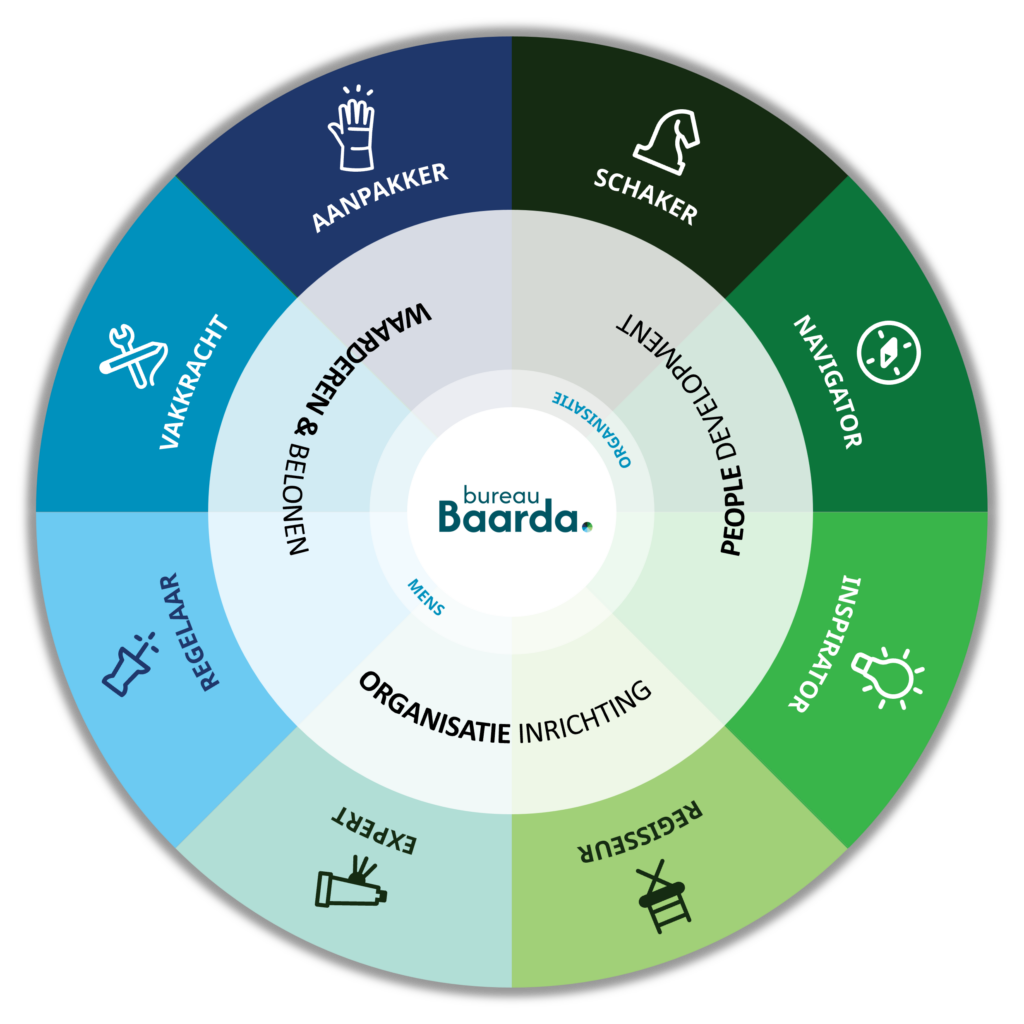
Eight roles, each with its own unique added value. Model Baarda helps organisations recognise and reward people based on their behaviour. Transparent, comparable and verifiable.
THEY WENT BEFORE YOU
Consumers’ Association
KWF
Port of Amsterdam
Enreach
HVC
Freshheads
WHAT IS MODEL BAARDA?
One clear language to recognise people’s worth fairly
Model Baarda assesses not only roles, but also people’s behaviour and problem-solving skills. It can be used for organisational design, appraisal, remuneration and people development. Always based on the same conviction: every individual brings added value.
Two types of problems
The type of problem someone solves determines their role. Model Baarda distinguishes between concrete and abstract problems.
Specific problems
A clearly defined end result. The requirements that the solution must meet are known in advance; the outcome is verifiable and reproducible.
Go-getter Skilled worker Controller Expert
Abstract problems
There is no single, clear-cut solution. The result cannot be measured, but must be underpinned by a vision and sound reasoning.
Director Inspirator Navigator Chess player
THE EIGHT ROLES
Click on a role and discover the added value
THE LEARNING PATH
Within every role, a person develops alongside it
From beginner to proficient, or sometimes even exceptionally proficient. This is how you make progress visible and open to discussion.
01
Junior
Is not yet fully familiar with the job, is learning the role and needs support to become independent.
02
Medior
Has largely mastered the role and works independently, occasionally seeking guidance when faced with new situations.
03
Full
Fully masters the role, works independently and helps others to develop.
04
Extraordinary
Goes beyond the role: innovates working methods and sets a new standard for others.
REWARDS & SALARY STRUCTURE
A balanced salary structure
In the Model Baarda pay scale, an employee’s remuneration is determined by their personal classification: their role and position on the career path.
A personalised approach is the starting point
Salary is determined by the employee’s role and position on the career path, not by their job title.
Baarda Salary Standard
Based on benchmark data for market-aligned and objective pay scales.
Salary growth
Salary increases in line with progression from junior to mid-level, senior and exceptional (BVL) levels.
Objective and fair
Based on demonstrable behaviour. This fosters trust and consistency throughout the organisation.
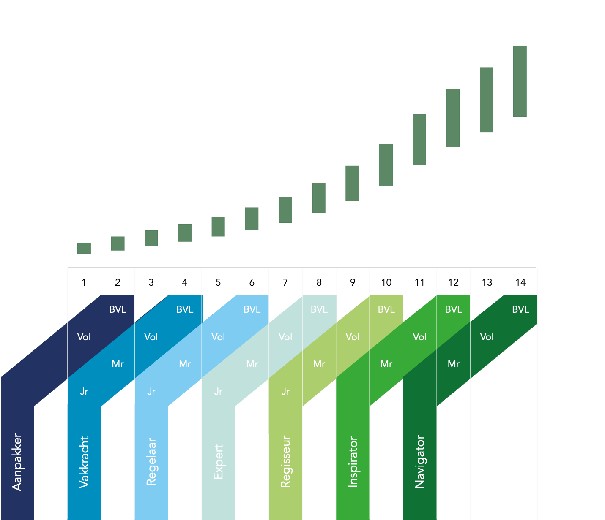
For each role, the career path progresses from junior (Jr) through mid-level (Mr) and senior (Vol) to exceptional (BVL). Each step corresponds to a higher pay scale.
HOW WE HELP
Three inseparable parts of a single whole
We always present our approach as a coherent whole, rather than as separate services. Organisational structure, development and remuneration are all interlinked.
1
Organisational structure
The right roles in the right place. Create a clear structure in which roles, responsibilities and added value are logically interlinked.
2
People development
Guide people through their learning journey, from junior to fully-fledged, with an understanding of mastery, autonomy, impact and ownership.
3
Recognising & rewarding
Recognise and reward people fairly, transparently and consistently, based on the value they add and their behaviour.
What a programme looks like
1
Explore
Together, we’ll analyse the issue, the context and your organisation’s ambitions.
2
Rate
We apply the Model Baarda approach: roles, behaviour and added value become visible and comparable.
3
Furnishing
We translate the findings into appropriate structures, remuneration policies and career paths.
4
Anchoring
We train managers and HR staff to ensure that the language continues to be used after the programme has ended.
WAGE TRANSPARENCY ACT
The law requires transparency.
We’ll teach you the language.
The EU Pay Transparency Directive requires organisations to provide objective justification for pay gaps. But providing objective justification starts with using the right language.
Substantiate objectively
Pay differences are explained on the basis of role and value added, not on the basis of negotiation or chance.
Equal pay for work of equal value
Work of equal value deserves equal pay, based on a neutral standard.
Duty to provide information
Employees and job applicants will be entitled to information on the criteria and salary ranges.
Reporting obligation
Larger organisations report on the pay gap and tackle unexplained differences.
Pay transparency with Model Baarda
Find out how to use Model Baarda functions to carry out objective appraisals and explain differences in pay, ensuring your organisation is compliant with the law. You’ll receive the white paper straight away by email.
PROODOSS
The model firmly embedded in your organisation
Proodoss is the digital extension of Model Baarda. Once a Baarda project has been completed, Proodoss helps to embed the model permanently and to develop staff in a targeted manner. From setting standards to reflection throughout the year, Proodoss completes the entire people development cycle.
1
Job matrix
Define the standard for the role: the role-based development pathway and the associated behaviour that staff can work towards.
2
Tests
Assess behaviour using 20 statements. This will help you identify what is already in place and what can be developed (further).
3
Ambitions
Make areas for development specific and clear. Ambitions provide a framework and direction.
4
Reflections
Encourage staff to reflect on their own development throughout the year.
5
Forms
Create company-specific forms for development reviews, reports or appraisal interviews.
6
Academy
Find out more about the model through background information and a short e-learning module.
TEAM BAARDA
The people behind Model Baarda

Arlène Speelman
Consultant

Mandy Eizema
Customer Success Manager

Erica Borgardine
Project Manager, Online Academy

Karlijn Versteeg
Customer Success Manager

Jesca Akkerman
Consultant

Carel Constandse
People Lead